The Water Hazard Nobody Talks About at the Barn
Every horse property I have ever set foot on has one. A stock tank. An irrigation ditch. A pond for the cattle or the geese or just because it was already there when you bought the place. We walk past these things a hundred times a summer without a second thought, because our brains are trained to watch the horse, watch the footing, watch the weather rolling in over the ridge. Nobody trains us to watch the water the same way, and that is a problem, because for the smallest kids on our properties, that stock tank is every bit as dangerous as a swimming pool.
I spent twenty years as an ER doctor before I started PresenceMD, and drowning calls are some of the ones that stay with you the longest. I will never forget the toddler who was at the local park and mom took her eyes off for just a minute to take the sibling to the bathroom. We tried for hours to save that sweet baby, but by the time someone noticed he was in the pond, it was too late.
When the American Academy of Pediatrics released an updated technical report this year reviewing decades of drowning prevention research, I paid attention. The numbers are not moving in the right direction. Child drowning deaths have been climbing since the pandemic, likely tied to disruptions in swim lessons and pool access, and July is consistently one of the deadliest months of the year for it.
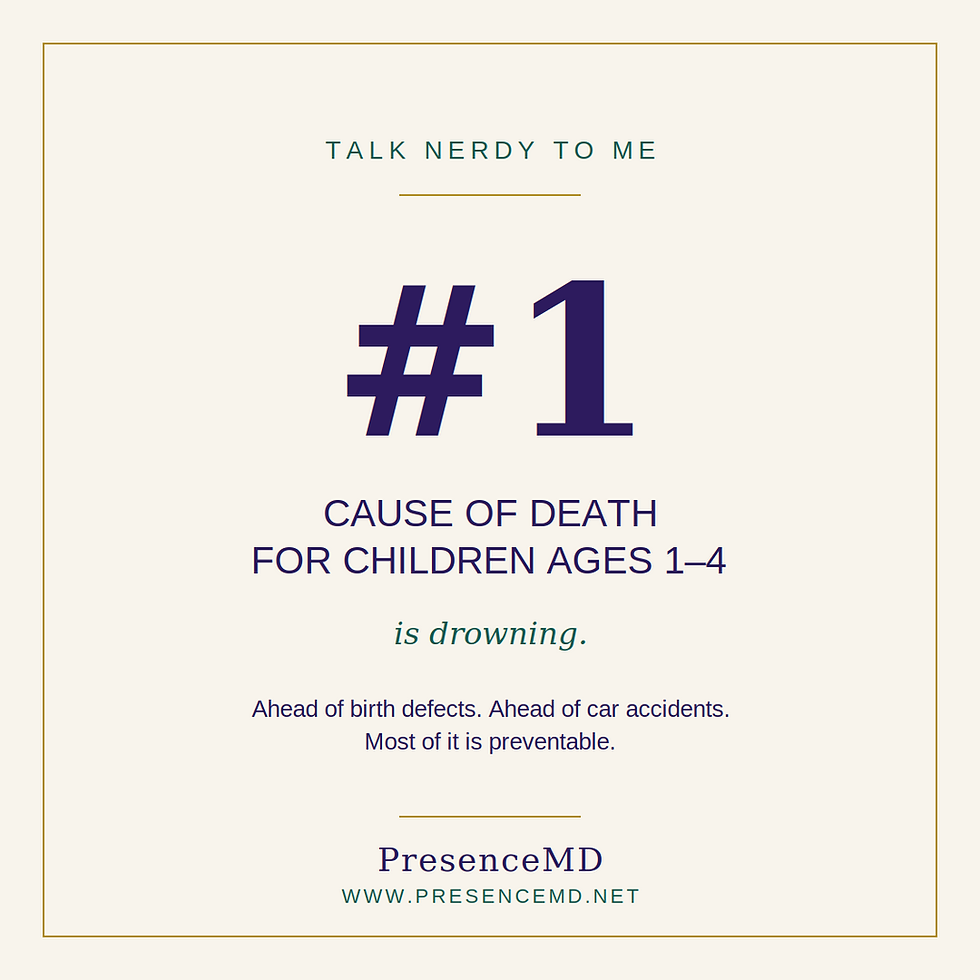
Here is the part that surprised me even after two decades of medicine. Drowning is the leading cause of death for kids ages one to four in this country, ahead of birth defects, ahead of car accidents, ahead of everything else. For kids five through fourteen, it is second only to motor vehicle crashes among unintentional injury deaths. This is not a rare tragedy. It is a common one, and the AAP report is blunt about the fact that most of it is preventable.
If you show, you already know your kids are around water constantly, and not always the kind with lifeguards. Stock tanks at the barn. RV parks with a pond out back. Airbnbs with a pool but no fence or alarm. Show grounds with a creek running along the property line. None of these get childproofed the way a backyard pool does, because we do not think of them as pools. A toddler does not know the difference. It only takes a few inches of water and a few unsupervised seconds.
The AAP report's central message is that no single safety measure works on its own. Prevention requires layers, stacked on top of each other, so that if one fails, another catches the fall. Here is what those layers look like.
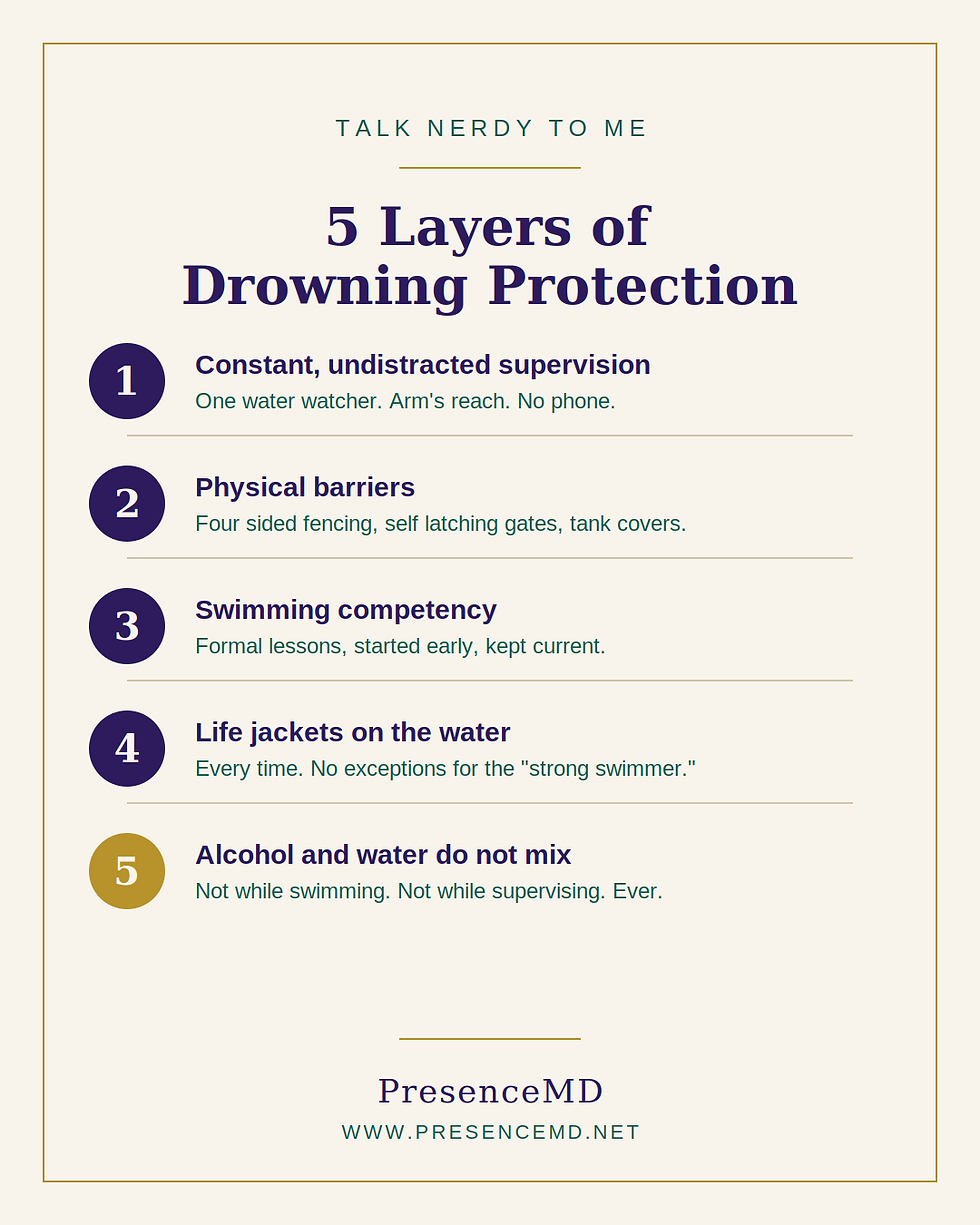
Constant, undistracted supervision. For toddlers and young kids, this means arm's reach, not just eyes on. The report recommends designating one adult as the water watcher whenever kids are near any water source, whether that is a pool, a tank, or a pond. That person's only job is watching. No phone, no beer, no conversation with the trainer about the next class. This single habit prevents one of the most common drowning setups there is, which is a group of adults all assuming someone else is watching the kid.
Four sided fencing for pools, and real barriers for tanks and ponds where fencing is not practical. A fence that separates the water completely from the house and yard, with a self closing, self latching gate, cuts drowning risk dramatically compared to a fence on only part of the property.
Swimming skills, taught early. Formal swim lessons reduce drowning risk in young children. This matters even more for horse families because a soaking wet, panicked child in a stock tank is a different situation than one in a backyard pool with a shallow end.
Life jackets on the water, every time, no exceptions for the kid who "swims fine." This applies to lakes, rivers, and boats, and it applies at the show grounds with a pond just as much as anywhere else.
Alcohol and water do not mix. The adults responsible for water watcher duties need to be sober. Adding alcohol to any type of water activity significantly increases the risk of drowning.
The report also found real, persisting disparities in who drowns. Among people under thirty, American Indian and Alaska Native individuals have the highest drowning death rates, followed by Black individuals, and Black children ages five to nineteen are over five times more likely to drown in swimming pools than white children in the same age group. These gaps are not biological. They trace back to generations of unequal access to swim lessons and safe places to swim, which is exactly the kind of structural problem that access to affordable instruction can start to close.
This week, I want you to walk your own property with fresh eyes. Look at every stock tank, every low spot that holds water after a storm, every irrigation ditch, and ask whether a toddler could reach it unsupervised. Talk to your barn family and your show friends about who is the designated water watcher at the next gathering where kids and water are both present. If your kids have not had formal swim lessons, this is the summer to start.
None of this requires a medical degree or a special piece of gear. It requires the same thing you already give your horse every single day, which is attention paid on purpose. Give your kids that same attention around water, and you stack the odds heavily in their favor.
If you have questions about summer safety for your family, on the show grounds or at home, reach out through www.presencemd.net. I would rather answer a question now than treat the emergency later.
TL:DR on the Study Link: https://publications.aap.org/pediatrics/article/doi/10.1542/peds.2026-077412/207631/Prevention-of-Drowning-Technical-Report
The basics: The American Academy of Pediatrics released an updated technical report in 2026 reviewing the scientific evidence on drowning prevention in children.
Who was in the study: This was not a single study of specific patients. It was a comprehensive review of decades of research and drowning death data across the United States, covering children from infancy through age nineteen.
What they did: A team of pediatric researchers led by Dr. Rohit Shenoi analyzed national drowning statistics along with the evidence behind common prevention strategies, including supervision practices, pool fencing, swim instruction, and life jacket use, then issued updated recommendations for families, doctors, and policymakers.
The results: In 2024, 1,075 children and teenagers younger than twenty died from unintentional drowning in the United States. Drowning is the leading cause of death for children ages one through four, and the second leading cause of unintentional injury death for children five through fourteen. Rates have risen since the pandemic. The report also found significant racial disparities, with American Indian, Alaska Native, and Black individuals under thirty facing the highest drowning death rates, differences tied to historical inequities in access to swimming lessons and safe pools rather than any biological cause.
Why it matters: Most drowning deaths involve more than one missing layer of protection at the same time, which means most of them are preventable with a handful of consistent habits.
The catch: No single strategy is enough by itself. A fence without supervision fails. Supervision without a fence fails. Swim lessons without a life jacket on a boat fails. Real protection means stacking multiple layers together, every time, not picking your favorite one.
How it works (probably): Drowning in young children is fast and silent, often taking under a minute and rarely involving splashing or calling out, which is why passive supervision, meaning an adult present but distracted, fails so often. Designating one undistracted adult as the water watcher, combined with physical barriers and swim skills, closes the specific gaps that passive supervision leaves open.
Comments